
From SEO to GEO: How to Get Your Business Recommended by ChatGPT, Google AI and Other AI Search Tools
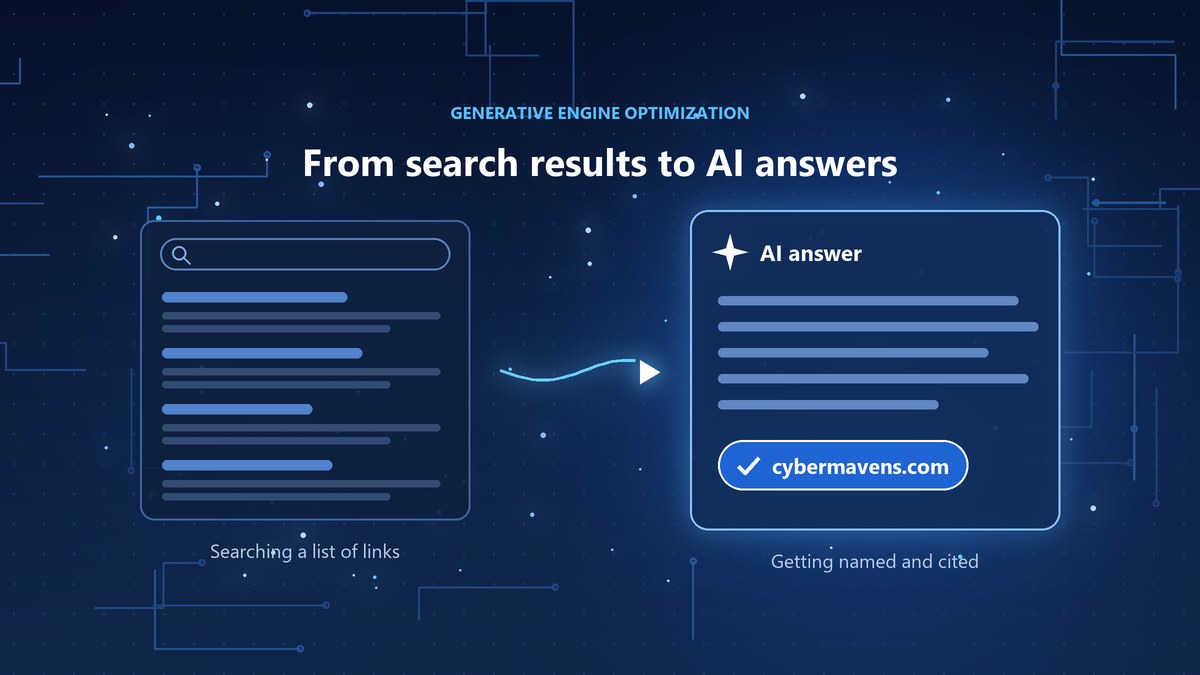
Back in 2019, as a new decade began, we wrote that if you were still relying on keywords and meta descriptions alone for search engine optimization, you were already behind. That’s even more true now, but the bigger change since then isn’t a new ranking trick. It’s how people search.
More and more customers don’t scroll through a page of links anymore. They ask a question in ChatGPT, Google’s AI Overviews, Microsoft Copilot, Perplexity or Claude, something like “Who can help my small business with data backup in Augusta?”, and get a single, written answer. If your business isn’t part of that answer, you may never get the chance to compete.
Making sure you’re included is called generative engine optimization (GEO).
What is GEO?
Generative engine optimization is the practice of making your business easy for AI tools to find, understand, trust and cite when they answer questions. Where traditional SEO aims for a high position in a list of links, GEO aims for something different: being named in the answer itself, ideally with a link back to your website.
Is SEO dead?
No. GEO builds on SEO; it doesn’t replace it. AI tools still find information by reading the web, and many of them lean on traditional search indexes to do it. A fast website, clear pages, and a good reputation in search engines remain the foundation. GEO adds a layer on top: shaping your content and online presence so an AI can confidently use it in an answer.
| Traditional SEO | GEO |
|---|---|
| Rank high in a list of links | Get named and cited in an AI answer |
| Target keywords | Answer real questions clearly |
| Win the click | Earn the recommendation |
| Focused on Google | Google, Bing, ChatGPT, Copilot, Perplexity, Claude and more |
How do AI tools decide which businesses to recommend?
No AI company publishes a complete formula, but the patterns are consistent. AI tools favor information that is:
- Clear and direct. Content that answers a question plainly is easier to quote than marketing language.
- Consistent. Your business name, address, services and contact details match everywhere they appear online.
- Corroborated. Other trusted sources, such as reviews, directories, partners and local news, say the same things about you.
- Current. Recent, maintained content signals an active business.
- Credible. Real people with real expertise stand behind the information.
Seven practical GEO steps for your business
- Answer the questions your customers actually ask. Add clear question-and-answer sections to your service pages, such as “How much does it cost?”, “How long does it take?” and “Do you serve my area?”. Put the answer in the first sentence.
- Add structured data. Behind-the-scenes code (schema.org markup) tells search engines and AI tools exactly who you are, where you are, what you offer and who works for you, with no guessing required.
- Make it easy for AI tools to read your site. Don’t block AI search crawlers in your site’s settings by accident, and keep important information in plain text rather than only inside images or PDFs. Some sites also publish a simple summary file for AI tools, known as llms.txt; it’s an emerging idea that isn’t officially used by every AI company yet, but it’s easy to add.
- Get your listings in order. Claim and complete your Google Business Profile, Bing Places and Apple Business Connect, with the same name, address and phone number everywhere. Don’t overlook Bing: several AI assistants draw on its search results.
- Earn reviews and mentions. Reviews from real customers, listings in respected directories, partner pages and local press all help AI tools trust that your business is real and reputable.
- Publish with expertise. Case studies and articles written by named experts, with specific details and real results, are exactly the kind of content AI tools like to cite.
- Keep it fresh. Update service pages when your offerings change and publish regularly, so both search engines and AI tools see an active business.
How do I know if AI tools are recommending my business?
Start simple: ask them. Open a few AI assistants and ask the questions your customers would ask, like “best IT consultant in Augusta, GA” or “who sells Datto backup near me?” Note whether your business appears, what’s said about you, and which sources are cited. Then ask new customers how they found you, and include “an AI assistant” as an option. Tools like Google Search Console and Bing Webmaster Tools also show how your site is performing in search, which feeds much of what AI tools see.
We practice what we preach
When we rebuilt the Cyber Mavens website, we built GEO in from the start: question-and-answer sections on every service page, structured data describing our business, services and team, and a site that’s fast and easy for both people and AI tools to read. We can do the same for your business.
Want to know how your business shows up in AI search? Contact the Cyber Mavens to schedule your free, two-hour consultation. We’ll check how AI assistants describe your business today and build a plan to improve it. Learn more about our digital marketing, SEO and GEO services.